Introduction
Diving watches are essential accessories for diving enthusiasts, as they provide vital information during underwater activities. In addition, these watches are designed to withstand water pressure and offer specific functions for both professional and amateur divers. In this glossary, we will explore the main terms related to diving watches, from the materials used in their manufacture to the features that make them ideal for diving.
Materials
Diving watches are typically made from water- and pressure-resistant materials such as stainless steel, titanium, and ceramic. Stainless steel is the most common material due to its durability and corrosion resistance. Titanium is lighter and stronger than stainless steel, making it a popular choice among divers looking for comfort and durability. Ceramic, on the other hand, is an innovative material that offers high resistance to scratches and wear, as well as being lightweight and hypoallergenic.
Water Resistance
Water resistance is a key feature of diving watches, as it ensures that the watch will function properly even at great depths. Diving watches are tested and rated according to the pressure they can withstand, and it is common to find ratings such as 100 meters, 200 meters or even 1000 meters of water resistance. It is important to note that the water resistance of a diving watch is not limited to depth alone, but also to exposure to salt water and temperature fluctuations.
Rotating Bezel
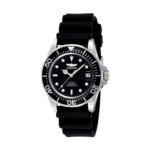
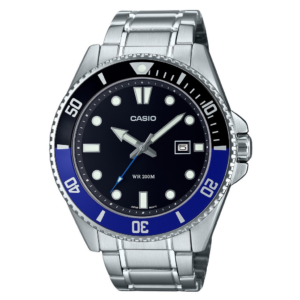
The rotating bezel is a distinctive feature of diving watches and is an essential tool for divers to accurately measure their dive time. The rotating bezel is a rotating bezel located around the watch face that can be adjusted to record dive time and aid in underwater navigation. Additionally, the rotating bezel often has markings or numbers that make it easier to read and track elapsed time.
Screw-down crown
The screw-down crown is another important feature of diving watches, as it ensures the watch is sealed and prevents water from entering during diving. A screw-down crown is a crown that can be screwed into the watch body, creating a hermetic seal that protects the watch's internal mechanism from water and pressure. In addition, the screw-down crown usually has a locking system that prevents it from being accidentally unscrewed during diving, ensuring the safety and functionality of the watch.
Lighting
Illumination is an essential feature of diving watches, as it allows divers to read the watch face in low visibility conditions. Diving watch illumination is usually done using luminescent materials, such as Super-LumiNova, which absorb light and emit a long-lasting glow in the dark. Additionally, some diving watches feature tritium gas-based illumination, which provides constant brightness and does not rely on exposure to light to recharge.
Chronograph
The chronograph is a common complication in diving watches, and is a function that allows precise measurement of time intervals. The chronograph is usually represented by small additional dials on the main dial of the watch, which can be operated by pushbuttons located on the side of the case. The chronograph in diving watches can be used to measure dive time, decompression intervals or even elapsed time during land-based activities.
Bracelet
The strap is the bracelet that accompanies the diving watch, and is an essential component to ensure the comfort and security of the watch on the diver's wrist. Diving watch straps are usually made of durable, water-resistant materials such as stainless steel, rubber or nylon. Additionally, diving watch straps often have diving extenders that allow the strap to be adjusted to accommodate wearing over a diving suit.
Caliber
The caliber is the heart of a diving watch, being the mechanism responsible for maintaining the accuracy and functionality of the watch. Diving watches are usually equipped with automatic or quartz movements, with automatic movements being the most common due to their accuracy and durability. The caliber of diving watches is designed to withstand the extreme conditions of diving, such as water pressure and temperature variations, ensuring that the watch functions correctly even in the most adverse situations.
Depth gauge
The depth gauge is a specific complication of diving watches, and is a function that allows divers to measure the depth at which they are diving. The depth gauge is usually represented by an additional scale or dial on the watch face, which displays the depth in meters or feet. Additionally, some diving watches have a depth alarm that alerts the diver when a predetermined depth is reached, ensuring safety during diving.
Pressure Compensator
A pressure compensator is an advanced feature of diving watches, a device that compensates for variations in atmospheric pressure during diving. The pressure compensator is usually represented by a valve located on the side of the watch case, which releases excess gas accumulated inside the watch to prevent damage to the internal mechanism. In addition, the pressure compensator ensures the accuracy of the watch during diving, even at high depths and with pressure variations.
Conclusion
In conclusion, diving watches are essential accessories for divers who seek functionality, durability and precision during underwater activities. With durable materials, specific features and advanced functionalities, diving watches are designed to withstand the extreme conditions of diving and provide vital information for divers. We hope this glossary has provided a comprehensive overview of the key terms related to diving watches, helping divers choose the ideal watch for their underwater adventures.


 English
  Portuguese
  Spanish
  French


 Sale! Select options
This product has multiple variants. The options may be chosen on the product page
Sale! Select options
This product has multiple variants. The options may be chosen on the product page